Looking to the future

Looking to the future
611 Bread of Life has made a significant investment in its AV infrastructure to simplify the AV workflow for its “family” of volunteers
A quarter of a century has passed since Reverend Joshua and his wife Delphine Cheung established the 611 Bread of Life Christian church in Hong Kong’s North Point district. Following a painstaking five-year conversion of a two-level derelict cinema in Tsuen Kwai Street, 611 Bread of Life began amplifying the word of God both internally and externally in 2014. Since making the church a home for its growing congregants, the production crew and stage talent have consistently relied upon advanced AV technologies to convey the message.
Located in a densely populated high-rise neighbourhood, the purpose-built, third-floor auditorium is devoid of the original horizontal pillars and corrugated metal roof that were architectural features prior to the conversion. Adopting a back-to-basics style of worship, the church has nevertheless installed a powerful AV inventory within the acoustically treated 45m x 40m (WxD) auditorium. To obtain an RT60 of 0.9, the walls of the 1,200-seat room were injected with acoustic foam diffusers in addition to being furnished with wooden absorbers and baffles.
The 611 leaders called upon the broadcasting expertise of Live Group Direct’s project director Mr Wan and technical director Cyril Lam. Enlisted to design and install an AVL system encompassing FOH audio and broadcast video production rooms, a motorised truss lighting system, an LED wall and IT network, the Live Group transformed the services within one of Hong Kong’s largest Christian churches.

Relocating to Hong Kong from Singapore in 2019, Wei Min Lim has further advanced the AV fortunes of 611 Bread of Life in his role as media pastor. Before stepping into full-time ministry, Lim gained vast experience managing a successful commercial filming agency. He also served at River Life Church in Singapore as media head for several years prior to his move.
Upon entering 611, Lim was initially impressed by the size of the church and the facilities, but soon realised that some of the technical setup required an overhaul. “There was a lack of technical volunteers to assist with all five Sunday services,” he recalls. “Audio was handled by a single engineer, mainly for monitors and a reliance on stage wedge monitors was creating a lot of spill and feedback. Front of house was managed by just one technician, and the control room had a very small team, consisting of one director, one CCU operator and a couple of people handling projection support. It was a very lean setup with around eight people running the entire service.”
Lim’s initial priority was to draft and train a young technical team. Having identified a deterioration of certain AV components, he started to create an AV media blueprint. Taking a 19-yearold with a passion for audio under his wing proved to be an inspirational step forward for 611. Since returning from Canada, Cyrus Kwok explored a range of upgrades, including connecting the network, wiring and creating schematics for systems integration. With growing confidence in his abilities, he has gradually applied his craft to advance the creative setup.

Building confidence with the leadership, Lim delivered weekly visual content over several months. Prior to the pandemic, a request to livestream a prayer meeting resulted in an upgrade of the original low-resolution streaming platform to HD.
“Despite the challenges, we pieced everything together and managed to deliver our first HD livestream,” explains Lim. “The pastors followed this up with a request for a livestream Bible school that would save on teacher travel budgets. By dismantling this setup, we rebuilt it in the Bible school using basic tools like OBS and Zoom. The enablement of remote teaching and interaction was a breakthrough moment as we executed this just before Covid fully hit.”
Like all other houses of worship, 611 was forced to close its doors during the pandemic. By organising temporary workstations, with multiple iMacs, the church became a production facility, where Lim organised intensive training sessions with his team of volunteers. “Ultimately, we broadcast more than 20 online services and created about 19 YouTube channels, with one for each ministry. Every department had its own content output, from children’s ministry to elderly and even specialised ministries.”
To support this initiative, the church approved a merger of the media and youth departments, which gave Lim access to a larger pool of young talent. “I prefer to appoint young people who might not excel academically but demonstrate strong hands-on skills who we can train with audio and video production. We started with a group of seven or eight young people, paying them small allowances and training them. They became the foundation of our team.”

Providing each ministry with access to a studio setup, the expanded team built a full production ecosystem with standardised workflows using PTZ cameras, Zoom and OBS, before upgrading to more advanced systems incorporating IP-based streaming. “Cyrus and his colleagues designed and built a centrally controlled livestream distribution platform requiring fewer operators,” furthers Lim. “As the team grew, we began developing more structured environments.”
The combination of that growing team and results-driven video figures pleased the pastors. Harbouring an ambition to build a dedicated broadcast centre with a master control room for directors and producers, Lim decided to submit his bold blueprint.
Slightly shocked by the scale of Lim’s vision, the church elders asked his wife to review his plan and delete any requirements that could be deemed personal rather than genuine. Consequently, Lim’s wife removed the camera jib on account that it would take up approximately 15 seats in a venue where every seat matters. Pleased with this amendment, the elders approved the remainder of the budget proposal.
Previously nicknamed the “mushroom room” because of humidity issues, the rear prayer room was converted and repurposed as the main broadcast and postproduction control space. “The air conditioning units did not fully function in this room. When it was used for prayer meetings, the worshippers were sweating, the room accumulated mould and mushrooms would grow. However, when we took over the space and used it as a video control room, the air conditioning miraculously worked and, since then, we haven’t had to change the air conditioning units and have operated here for several months with some computers placed on temporary tables, before the custom desks were fitted.”

4K wireless transmissions over fibre were previously stored on a server with 4TB hard disks as a backup. With the focus firmly on increasing workflow efficiencies, server-based ingest systems were created to handle the multiple high-resolution recordings. With media, IT and finance merged within the same department, the infrastructure for livestreaming can now be scaled according to the church’s needs when using multiple network lines. Capable of managing petabytes of data and content, the media centre runs on 10G networks and there is no need to ingest.
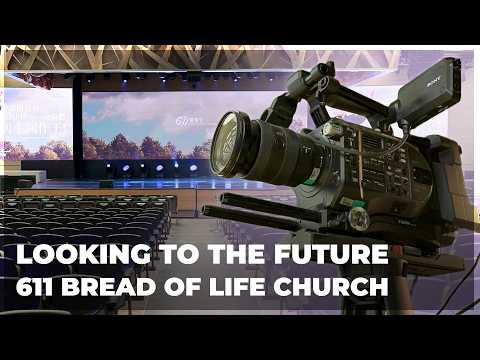
“During a typical Sunday service, the production team consists of a live camera crew operating up to 12 production cameras, including two Sony HDC-5500 units and a Canon box camera with a 66x zoom lens and image stabiliser. If the volunteer operator shakes, the image does not. We also deploy Sony FX3 cameras as production cameras creating a hybrid broadcast environment. Because the pastor loves playing basketball, we have suspended a basketball in front of the camera that he needs to look at. During our broadcasts, his eye line is perfect, as it aligns with the basketball.”
The church carries a large inventory of Blackmagic Design video hardware for its price-performance credentials. Upon Kwok’s recommendation, a Blackmagic ATEM Constellation 8K Pro switcher and Videohub 80x80 connected to 20 sets of Hyperdeck Studio 4K Pro have been added to the video production suite at the rear of the sanctuary.
Specifying a Blackmagic platform helped Lim to reduce the cost of the setup. “Blackmagic Design technology has been transformative for us,” he adds. “In the past, broadcast systems required significant investment and large teams, but Blackmagic has made it possible to scale these capabilities at a much lower cost. This technology allows us to deploy systems across multiple rooms and train people at every level, and cost efficiency includes redundancy and scalability.”

Initially cited as an audio broadcast room, the live translation booth was based on a vague room plan drawn by Lim, before being designed in AutoCAD by Kwok. To accommodate the volunteers, two adjacent air-conditioned rooms equipped with Shure SM7B microphones and Amphion monitors including subwoofers were created. For broadcast mixing on a DAW, the volunteers have been trained to operate Mac Pro Max Packs loaded with Apple Logic Pro and Reaper recording software for up to 120 tracks.
In addition to designing and building these rooms, Lim played a role in building the team and can take credit for the positive impact this has had on people’s lives. “Our volunteers range from professionally trained directors and producers, to students, school teachers, engineers and retired uncles and aunts. This community is more like a family, and I don’t want them to feel stressed during a production. It is our job to simplify the AV workflow processes and to ensure the volunteers only have one job to fulfil. We run five services here each week, but we are in the fortunate position today whereby we can call upon different volunteers for each service.”
From the control surface of the ATEM 2 M/E Advanced Panel surface, a director or a producer controls the Sony broadcast cameras and Sony FX3 on Teradek wireless transmitters, which are then transferred to any one of eight sets of AJA Colorboxes for postproduction editing. Receiving the director’s cut, the producer has access to all the camera inputs together with content from five Mac Studios, the Pro Presenter and Resolume Arena software, including lyrics, words, pictures and controls for inputting onto the main LED.
In postproduction, the audio signal is transferred to four SSL UF8 digital audio workstations with UC1 plugin controls, with the final workstation used for last-minute additions. Processed and produced in Logic Pro, the visual image is synced and embedded before being broadcast on Facebook and YouTube. Designed by Rocky and built internally, the DAW-based audio broadcast system with plugins and processing manages over 100 channels. Monitored over Amphion speakers, the postproduction team also has access to an SSL Fusion processor, an SSL Bus+ compressor and a UA Apollo x8P interface. A Midas Heritage HD96 digital console works as a backup system, with its intuitive layout helping to simplify the production for the volunteers.

Providing standardisation and familiarity of use in the church, both the front of house and monitor consoles are Midas Heritage HD96 control surfaces. “It’s a very warm console and in terms of price-performance, takes some beating as the preamps are amazing,” says Lim. “For audio, we benefit from a split gain structure including Radial OX8 passive mic splitters. With the microphone feeds separated and simultaneously sent to front of house, broadcast and monitoring mixes, the three console operators maintain their own individual gain structure.”
The OX8 3-way splitters receive UHF transmissions from up to 54 Shure QLXD4 receivers via the wireless antenna system. Also racked backstage, 15 Prism Atlas 8-input multitrack interfaces have been added to process the gain signals for the broadcast feed and routed to six sets of Midas DL231 24-channel and three sets of Midas DL251 stageboxes. Acquired in 2019, the 54 Shure QLX-D transmitters paired with 30 bodypacks and headsets for the actors and singers onstage provide ease-of-use setups.
Playing a large role in conveying the church’s message, 611 stages dramas and large musical productions. “During Covid, our members grew weary of watching our services online but, by creating dramas, we grew the audience and a lot of people now come and watch these performed at the church. They wanted to take their productions to a higher level but, because the media team wasn’t equipped for the challenge, we made this our priority.”
Over seven years, 611 has produced a staggering volume of content, livestreams, recorded shows and worship productions. Lim’s goal is to welcome over 100 worldwide branches connected over IP control over the next three years. “Many other churches have started to follow our livestream broadcasts and have openly expressed a desire to mimic our setup. As a result, we have provided them with tours and educated them on how to create a more scaled-down, cost-effective version of their own bespoke setups. The production videos we now produce for other churches is a first in Hong Kong.”
With technology, and especially AI, evolving rapidly, Lim’s focus going forward is to equip the younger generation to lead in the future. “It was a high investment, but the pastors appreciate and understand that the upgrade is paying for itself. In parallel, the church can now select from its dedicated team of 100 volunteers each week to run its services. We are extremely proud of the volunteers who operate within the same workflow. From children as young as six years old to volunteers in their 70s, we’ve built an inter-generational team, progressing through different levels as they grow.”


